Showing posts with label Scholastic. Show all posts
Showing posts with label Scholastic. Show all posts
Friday, October 19, 2007
First two reports from New York
Bloomberg.com and The Leaky Cauldron have the first two reports on Rowling's visit to New York this morning (there is another one tonight). It looks like there were some very good questions!


Wednesday, October 17, 2007
Mary GrandPré video highly recommended
I will get to today's MTV article, but first I want to recommend a wonderful, nearly 30 min. video of Mary GrandPré showing a room of Minnesota children how she draws Harry. It is just so awesome to watch his face emerge from the paper, and hear her funny asides about Hagrid, Krum, Harry, and Harry's scar. The kids are great too.
Sunday, September 23, 2007
Rowling to visit Toronto too!
Raincoast Books has announced that J.K. Rowling will make an appearance at Toronto's Winter Garden Theatre on October 23rd to do a reading, a question-and-answer session (yes!) and then sign books. This event will follow the three previously announced appearances in Los Angeles (October 15th), New Orleans (October 18th), and 2 in New York City (October 19th).
I did not get drawn in the NY sweepstakes *sobs quietly* so if any of you will be there and would like to do a report for us, please contact me at accioquote@gmail.com.
I did not get drawn in the NY sweepstakes *sobs quietly* so if any of you will be there and would like to do a report for us, please contact me at accioquote@gmail.com.
Wednesday, July 25, 2007
Minnesota Public Radio interviews Mary GrandPre
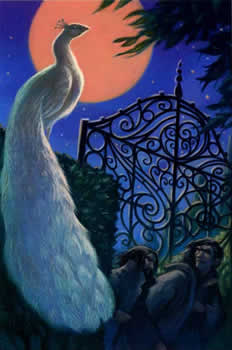 Frontispiece, Deluxe edition of Harry Potter and the Deathly Hallows. Copyright 2007 Mary GrandPre.
I am listening to a nice long (spoiler-free) interview of Mary GrandPre, the illustrator of the American editions of the books. Minnesota Public Radio's Tom Crann asks a lot of questions about how the artwork comes about, how much artistic license she has, what she feels is so special about the books, and how she was chosen in the first place. Real Player is required; the show was broadcast July 23rd.
Hopefully GrandPre will be interviewed again when she can talk freely about why she chose the specific design elements for the Deathly Hallows covers.
Friday, July 20, 2007
Scholastic video of "Potter Place" and first signed copy of Deathly Hallows
Take a look at video of Scholastic's launch of "Potter Place" in New York. I wish I was there!
So that's how you pronounce Pensieve??? PON-siv, not PEN-seev.
Update: Bandersnatch has translated the Futhorc runes that run around the edge of the Pensieve in the video, and they say "Who will live and who will die?" and "There will soon be seven." We can't see the whole rim, but it seems that all seven of Scholastic's questions are represented in the design! Futhorc runes are the same ones that Tolkein used for the frontispieces and one of the maps he drew for The Hobbit and his Lord of the Rings books.
Update #2: I noticed in a video of Jo that she pronounced Pensieve PEN-siv. I have had the pleasure of hearing uber-Librarian Nancy Pearl talk several times, and one of the funny soliloquies she does is about how book readers often mis-pronounce things because we have only read them not heard them.
So that's how you pronounce Pensieve??? PON-siv, not PEN-seev.
Update: Bandersnatch has translated the Futhorc runes that run around the edge of the Pensieve in the video, and they say "Who will live and who will die?" and "There will soon be seven." We can't see the whole rim, but it seems that all seven of Scholastic's questions are represented in the design! Futhorc runes are the same ones that Tolkein used for the frontispieces and one of the maps he drew for The Hobbit and his Lord of the Rings books.
Update #2: I noticed in a video of Jo that she pronounced Pensieve PEN-siv. I have had the pleasure of hearing uber-Librarian Nancy Pearl talk several times, and one of the funny soliloquies she does is about how book readers often mis-pronounce things because we have only read them not heard them.
Thursday, July 12, 2007
Washington Post article on Arthur Levine
If I was putting together a dream dinner party, Arthur Levine would be one of the guests; he is always so articulate, book-focused, and informative.
Well lucky us, The Washington Post has published another interview of the man who brought Potter to America, "The Wizardly Editor Who Caught the Golden Snitch." It's a lovely read. No spoilers, of course!
Well lucky us, The Washington Post has published another interview of the man who brought Potter to America, "The Wizardly Editor Who Caught the Golden Snitch." It's a lovely read. No spoilers, of course!
Thursday, June 28, 2007
New article on unprecedented security for Book 7
Time Magazine writers Lev Grossman and Andrea Sachs have posted a very interesting piece today entitled "Harry Potter and the Sinister Spoilers" about the security for Book 7. Have you ever wondered how exactly the manuscript for Deathly Hallows was sent from Jo to her editors? Who has read the book and what keeping the secret is like? Grossman closes with something to chew on:
But even if the spoilers were genuine, it wouldn't matter.Hmmm. On that note, I will say that this article contains no details about spoilers, alleged or otherwise. =) Thanks to Meann for the tip!
On this point, both hacker [Gabriel] and publisher share a key misunderstanding of what reading is all about. People read books for any number of reasons; finding out how the story ends is one among many and not even the most important. If it were otherwise, nobody would ever bother to read a book twice. Reading is about spending time with characters and entering a fictional world and playing with words and living through a story page by page. The idea that someone could ruin a novel by revealing its ending is like saying you could ruin the Mona Lisa by revealing that it's a picture of a woman with a center part. Spoilers are a myth: they don't spoil. No elaborate secrecy campaign is going to make Harry Potter and the Deathly Hallows any better than it already is, and no website could possibly make it useless and boring.
Friday, June 08, 2007
Deluxe edition cover art!
 Oh my goodness, we finally have Deluxe edition (U.S.) cover art!
 Later edit:
I have been reading some wonderfully creative theories! My own contribution to the nuttiness is in the comments.
From the Scholastic Press Release: David Saylor, Vice President, Creative Director, Scholastic described the art as:
Set during a highly dramatic sunset, Harry, Hermione, and Ron–clothes in tatters–cling atop a flying dragon in this astonishing artwork created by Mary GrandPre for the deluxe edition. As mist creeps down towering hillsides to a village below, questions arise about where the trio is headed and what has led them to this spellbinding moment.
The covers were revealed this morning by Arthur A. Levine on the Today Show (NBC). According to their webpage, "Arthur said the image on the cover is one of his favorite scenes in the book and he specifically asked that it be the image of the deluxe cover."
Usually there is also bonus art inside the deluxe edition. According to the press release, Here’s what we still haven’t seen yet:
* never-before-seen full color frontispiece art on special paper.
* "Illustration Showcase" insert that features near scale reproductions of Mary GrandPre's chapter openers
* bonus black-and-white illustration that appears at the end of the "Illustration Showcase"
The deluxe edition will be a total of 816 pages; the suggested retail price is $65.00 and the print run will be 100,000 copies.
Tuesday, May 29, 2007
PotterCast interview of Arthur Levine added
 Well, it was broadcast over a year ago, but here it is, Melissa Anelli's extensive interview of Rowling's American editor, Arthur Levine.
 This interview provides the most authoritative information on how Harry Potter and the Sorcerer's Stone got to be published in America, why the title was changed, what Scholastic's editing process is like -- everything.
Saturday, April 21, 2007
NYT interviews Scholastic CEO
Rozhon, Tracie. "Saturday Interview: A Brief Walk Through Time at Scholastic" New York Times, 21 April 2007
Wandering through the headquarters of Scholastic in Manhattan is like taking a trip back through time and childish dreams, to a fantastical kindergarten with brightly colored columns and desk dividers and, at the very end, a huge playroom filled with toys like Clifford the Big Red Dog and Goosebumps and Captain Underpants and, of course, J. K. Rowling’s books about Harry Potter and his comrades.
The playroom, actually the company’s conference room, was the site of an interview with Richard Robinson, 69, only the second chief executive the company has had in its 86-year history; the first was his father.
Now chairman and chief executive of a $2.2 billion company, Mr. Robinson began by stressing that the Harry Potter book revenue makes up a small part of the company’s total and he intimated that there could be another best-selling series to come — from the same author.
Following are excerpts of the conversation, which ranged from using new technology to teach reading, to India and China, and back to you know who, Harry Potter:
Q. So where is Scholastic bound after the last Harry Potter book? Can we believe it’s the last book?
A. We can believe this is the last book on Harry Potter. We look at Harry Potter as a wonderful icing on top of the cake, but we are essentially a children’s book and media company, with our own distribution network and book clubs. There’s no question that Harry Potter gave us a big boost. It brought us name recognition, but Harry Potter never exceeded 8 percent of our total revenue.
Q. How did you get Harry Potter in the first place — it was first published in England, wasn’t it?
A. She had written her first book, and it was published in England. She then went through the English version of the Yellow Pages and looked for an agent. She says she just liked the name Christopher Little — she’s a whimsical character — and he directed the auction for rights outside the U.K. We spotted the book — Arthur Levine, an editor here, did — and we bid $105,000, which was quite a bit for an unknown author.
Q. Unknown?
A. Yes, at the beginning, people didn’t know what they had. The first story had been simple. It wasn’t until the second book that there was a groundswell.
Q. Going back to our first question, I noticed you emphasized the words Harry Potter when you said Ms. Rowling’s last book on Harry Potter. Do you have a first option on any other series she might be doing?
A. No, but we refer to ourselves as her U.S. publisher and she’s very loyal to us and we’re very loyal to her. We’ll keep working together. It’s less likely we won’t get it. It’s more likely it won’t be another Harry Potter.
Q. The company your father founded is now 86 years old. Have you seen a lessening of interest in reading among children, with the Internet and all the new technologies?
A. NAPE [National Assessment of Educational Progress] statistics will tell you there has been some reduction in reading skill. But there were always a lot of people who didn’t read much. Q. So what are you doing in places like China and India?
A. We are reaching out. We’re a global company in 65 countries, and offices in 15 of them, including China, India and Southeast Asia. There is a different situation there, with a growing middle class with dedicated parents driving their kids to achieve, and the kids are desperate to learn and to succeed. It’s that group we’re focusing on in Asia. Our pricing there is quite low; they don’t pay $5 for a book, they might pay $1 or $2.
Q. Are they abridged, then?
A. No, they’re the American classics, with some Indian literature that is written and developed there — they just might not be on the same type of paper. In developing literacy, we work with all the agencies we can find. In India, people already read English. In China, they want to learn English. The books are in English.
Q. So you’re not bewailing the fact that kids are not reading as well, or as much, as they used to?
A. No, not really. If you look at the deep research, you’ll see that technology can help kids learn to read. After all, to get stuff off the search engines, you have to be able to read. I see this as a 20-year process that began maybe five years ago. We’ll see more about the impact of technology and the interaction between graphics and words. After all, if we think of reading as visualizing in your mind, there could easily be a rebirth of intellectual activity, whether you call it “reading” or not, and I would.
Q. So you’re optimistic?
A. We’ve struggled with what I’d call words on a printed page, and with all the new technologies. I would say Scholastic is at the forefront of those new technologies.
Q. Getting back to Harry Potter, when is the last book coming out?”
A. Well, “Harry Potter and the Deathly Hallows” comes out on July 21st. We think slightly more copies than the preceding ones, which have gone up every time.
We think that there are some people who have read one, two and three, but not read four, five and six — they got darker and more complicated — but who will want to see how it ends.
Q. Yes, speaking of how it ends, we’ve heard that two people get killed. Can you say who they are? And people also want to know if Harry and Hermione finally, er, get together in the end?
A. (Laughs) I don’t even know. Really. There’s a small number who read the book. I don’t. I’m sure she thinks of the ending of Charles Dickens’s Little Nell, when people were waiting at the boat docks for the last sequel — to see if Little Nell was going to die. You know, one of the great things is getting people to imagine what’s going to happen: my 10-year-old has an absolutely brilliant interpretation. We’re starting a campaign for teachers to use in classrooms: seven questions, including who lives and who dies. Many people, including world-famous authors, are trying to figure out how it will end.
Q. Then, of course, there’s the movie that’s coming out in December, “The Golden Compass,” with some big stars.
A. Well, you know, being part of the movie business isn’t new for us. A lot of movies are made from books we sell, so if you have a property — like “The Big Red Dog” or “The Magic Bus” or “Goosebumps” — you can create a television show or a movie.
Q. How is that end of the business doing?
A. It gets harder to create new TV shows.
Q. Why?
A. It’s harder to create television hits because of all the cable channels. It’s becoming more fragmented. We work closely with PBS — it used to be a national network that reached everybody. Although there’s Nickelodeon and the Cartoon Network, it’s still a small percentage. We are working with studios to develop properties, without putting any money into it. They put up the money, but we put in a lot of work; it’s a wonderful partnership.
Q. What about “The Golden Compass?”
A. You may not be familiar with “The Golden Compass” series, but it rivals Harry Potter in England. Daniel Craig and Nicole Kidman are in it, yes, but the star will be the child: an 11-year-old tiny thing, she’s getting big! She and the polar bear are the true heroes. It’s an epic trilogy, and it was written before Harry Potter. A good and evil story, very imaginative, very metaphorical.
Q. The movie may make the books sell better. Are you the publisher?
A. I hope it does. We publish them in England, Random House publishes them in the United States.
Q. Moving to the business side, why did the stock dip so precipitously near the end of March? It’s recovered somewhat but is still less than it was.
A. (Nods) One of our businesses: the continuity business. That delivers children’s books like the Book of the Month Club does, every four weeks. We’ve changed the business to switch it to the Web and reduced the size. As we switched over to the Web, we decided to take a more conservative view, and we decided to write off promotional costs, and the Street took a slightly dim view of our actions.
Q. How do you view Scholastic’s stock price, which is now $31.98?
A. We went public in the late ’60s and we went private in the mid-’80s. We were out for five years and then we went back to the public markets in ’92. The stock has gone up and down, to keep pace with what’s going on, you have to change your methods of communication, move more to the Web. We partner with teachers to make their classrooms more interesting, and we’ve moved a lot of selling over to the Web.
Q. You said you have a large book club business. How has the Web affected that?
A. Half of the book club orders are Web based.
Q. How is Scholastic’s business divided up?
A. Children’s books, which includes the book clubs, makes up 60 percent. Education — materials sold to schools — makes up 20 percent. The rest is our international business.
Q. Still, the 8 percent for Harry Potter is a significant part of the business.
A. Yes, nothing will be like Harry Potter, but Goosebumps sold as many copies — it’s just that they’re paperbacks, so they’re a much lower price. They’re fun and scary and people love them — they’re a big seller in China: 300 or 400 million copies! But they’re lots of other things that could be phenomena. At Scholastic, we are constantly trying to create such things.
Wandering through the headquarters of Scholastic in Manhattan is like taking a trip back through time and childish dreams, to a fantastical kindergarten with brightly colored columns and desk dividers and, at the very end, a huge playroom filled with toys like Clifford the Big Red Dog and Goosebumps and Captain Underpants and, of course, J. K. Rowling’s books about Harry Potter and his comrades.
The playroom, actually the company’s conference room, was the site of an interview with Richard Robinson, 69, only the second chief executive the company has had in its 86-year history; the first was his father.
Now chairman and chief executive of a $2.2 billion company, Mr. Robinson began by stressing that the Harry Potter book revenue makes up a small part of the company’s total and he intimated that there could be another best-selling series to come — from the same author.
Following are excerpts of the conversation, which ranged from using new technology to teach reading, to India and China, and back to you know who, Harry Potter:
Q. So where is Scholastic bound after the last Harry Potter book? Can we believe it’s the last book?
A. We can believe this is the last book on Harry Potter. We look at Harry Potter as a wonderful icing on top of the cake, but we are essentially a children’s book and media company, with our own distribution network and book clubs. There’s no question that Harry Potter gave us a big boost. It brought us name recognition, but Harry Potter never exceeded 8 percent of our total revenue.
Q. How did you get Harry Potter in the first place — it was first published in England, wasn’t it?
A. She had written her first book, and it was published in England. She then went through the English version of the Yellow Pages and looked for an agent. She says she just liked the name Christopher Little — she’s a whimsical character — and he directed the auction for rights outside the U.K. We spotted the book — Arthur Levine, an editor here, did — and we bid $105,000, which was quite a bit for an unknown author.
Q. Unknown?
A. Yes, at the beginning, people didn’t know what they had. The first story had been simple. It wasn’t until the second book that there was a groundswell.
Q. Going back to our first question, I noticed you emphasized the words Harry Potter when you said Ms. Rowling’s last book on Harry Potter. Do you have a first option on any other series she might be doing?
A. No, but we refer to ourselves as her U.S. publisher and she’s very loyal to us and we’re very loyal to her. We’ll keep working together. It’s less likely we won’t get it. It’s more likely it won’t be another Harry Potter.
Q. The company your father founded is now 86 years old. Have you seen a lessening of interest in reading among children, with the Internet and all the new technologies?
A. NAPE [National Assessment of Educational Progress] statistics will tell you there has been some reduction in reading skill. But there were always a lot of people who didn’t read much. Q. So what are you doing in places like China and India?
A. We are reaching out. We’re a global company in 65 countries, and offices in 15 of them, including China, India and Southeast Asia. There is a different situation there, with a growing middle class with dedicated parents driving their kids to achieve, and the kids are desperate to learn and to succeed. It’s that group we’re focusing on in Asia. Our pricing there is quite low; they don’t pay $5 for a book, they might pay $1 or $2.
Q. Are they abridged, then?
A. No, they’re the American classics, with some Indian literature that is written and developed there — they just might not be on the same type of paper. In developing literacy, we work with all the agencies we can find. In India, people already read English. In China, they want to learn English. The books are in English.
Q. So you’re not bewailing the fact that kids are not reading as well, or as much, as they used to?
A. No, not really. If you look at the deep research, you’ll see that technology can help kids learn to read. After all, to get stuff off the search engines, you have to be able to read. I see this as a 20-year process that began maybe five years ago. We’ll see more about the impact of technology and the interaction between graphics and words. After all, if we think of reading as visualizing in your mind, there could easily be a rebirth of intellectual activity, whether you call it “reading” or not, and I would.
Q. So you’re optimistic?
A. We’ve struggled with what I’d call words on a printed page, and with all the new technologies. I would say Scholastic is at the forefront of those new technologies.
Q. Getting back to Harry Potter, when is the last book coming out?”
A. Well, “Harry Potter and the Deathly Hallows” comes out on July 21st. We think slightly more copies than the preceding ones, which have gone up every time.
We think that there are some people who have read one, two and three, but not read four, five and six — they got darker and more complicated — but who will want to see how it ends.
Q. Yes, speaking of how it ends, we’ve heard that two people get killed. Can you say who they are? And people also want to know if Harry and Hermione finally, er, get together in the end?
A. (Laughs) I don’t even know. Really. There’s a small number who read the book. I don’t. I’m sure she thinks of the ending of Charles Dickens’s Little Nell, when people were waiting at the boat docks for the last sequel — to see if Little Nell was going to die. You know, one of the great things is getting people to imagine what’s going to happen: my 10-year-old has an absolutely brilliant interpretation. We’re starting a campaign for teachers to use in classrooms: seven questions, including who lives and who dies. Many people, including world-famous authors, are trying to figure out how it will end.
Q. Then, of course, there’s the movie that’s coming out in December, “The Golden Compass,” with some big stars.
A. Well, you know, being part of the movie business isn’t new for us. A lot of movies are made from books we sell, so if you have a property — like “The Big Red Dog” or “The Magic Bus” or “Goosebumps” — you can create a television show or a movie.
Q. How is that end of the business doing?
A. It gets harder to create new TV shows.
Q. Why?
A. It’s harder to create television hits because of all the cable channels. It’s becoming more fragmented. We work closely with PBS — it used to be a national network that reached everybody. Although there’s Nickelodeon and the Cartoon Network, it’s still a small percentage. We are working with studios to develop properties, without putting any money into it. They put up the money, but we put in a lot of work; it’s a wonderful partnership.
Q. What about “The Golden Compass?”
A. You may not be familiar with “The Golden Compass” series, but it rivals Harry Potter in England. Daniel Craig and Nicole Kidman are in it, yes, but the star will be the child: an 11-year-old tiny thing, she’s getting big! She and the polar bear are the true heroes. It’s an epic trilogy, and it was written before Harry Potter. A good and evil story, very imaginative, very metaphorical.
Q. The movie may make the books sell better. Are you the publisher?
A. I hope it does. We publish them in England, Random House publishes them in the United States.
Q. Moving to the business side, why did the stock dip so precipitously near the end of March? It’s recovered somewhat but is still less than it was.
A. (Nods) One of our businesses: the continuity business. That delivers children’s books like the Book of the Month Club does, every four weeks. We’ve changed the business to switch it to the Web and reduced the size. As we switched over to the Web, we decided to take a more conservative view, and we decided to write off promotional costs, and the Street took a slightly dim view of our actions.
Q. How do you view Scholastic’s stock price, which is now $31.98?
A. We went public in the late ’60s and we went private in the mid-’80s. We were out for five years and then we went back to the public markets in ’92. The stock has gone up and down, to keep pace with what’s going on, you have to change your methods of communication, move more to the Web. We partner with teachers to make their classrooms more interesting, and we’ve moved a lot of selling over to the Web.
Q. You said you have a large book club business. How has the Web affected that?
A. Half of the book club orders are Web based.
Q. How is Scholastic’s business divided up?
A. Children’s books, which includes the book clubs, makes up 60 percent. Education — materials sold to schools — makes up 20 percent. The rest is our international business.
Q. Still, the 8 percent for Harry Potter is a significant part of the business.
A. Yes, nothing will be like Harry Potter, but Goosebumps sold as many copies — it’s just that they’re paperbacks, so they’re a much lower price. They’re fun and scary and people love them — they’re a big seller in China: 300 or 400 million copies! But they’re lots of other things that could be phenomena. At Scholastic, we are constantly trying to create such things.
Tuesday, March 20, 2007
Deathly Hallows Page Count!
Scholastic made their official announcement today about the page count for Harry Potter and the Deathly Hallows: it will be 784 pages, which makes it the second largest book in the series. (Harry Potter and the Order of the Phoenix is 870 pages.)
Our new Accio Quote! staffer Jules dug up this quote from Jo's website which is quite apropos of the moment:
Our new Accio Quote! staffer Jules dug up this quote from Jo's website which is quite apropos of the moment:
FEBRUARY 28th 2006Jules and I say "Thanks for the extra chapters Jo!"
'This always happens. I make a plan, it looks nice and neat, then I get to actually write the book and realise that Harry can't possibly do all that in just one chapter. So what I thought were going to be two chapters have now become four. I still don't think the book [Book 7] will be as long as 'Phoenix', but if that keeps happening... no, it won't. I'm looking at the plan, and it can't. Surely. Please.
Nothing else I can tell you at the moment. Well, there's LOADS I could tell you at the moment, but I can't. Sorry'.
Subscribe to:
Posts (Atom)
